
What Is Forex Trading? (Complete Beginner’s Guide)
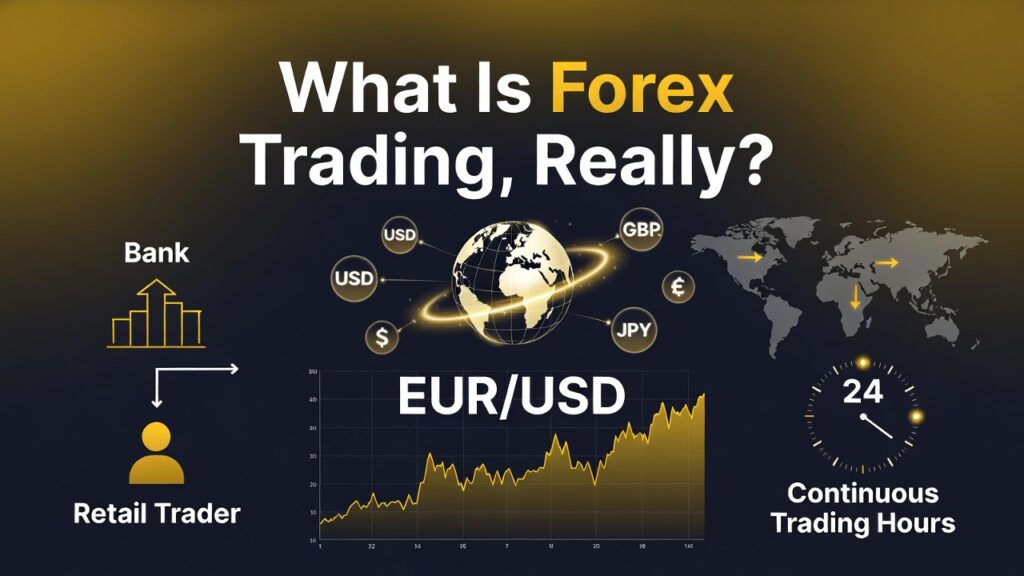
Forex trading — short for foreign exchange trading — is the simultaneous buying of one currency and selling of another, with the objective of profiting from changes in the exchange rate between them.
When you see EUR/USD quoted at 1.0850, that number tells you exactly how many US dollars one Euro will buy. If you believe the Euro will strengthen against the dollar, you buy EUR/USD. If it moves from 1.0850 to 1.0920, you’ve captured 70 pips of profit. If it drops to 1.0780, you’ve taken a 70-pip loss.
That’s the core mechanics. But here’s what the textbooks skip: forex trading is not gambling, and it’s not a shortcut to wealth. It’s a probabilistic business where edge, discipline, and risk management determine who survives.
The forex market is the largest financial market in the world by a significant margin. According to the Bank for International Settlements (BIS) 2022 Triennial Central Bank Survey, daily forex trading volume reached $7.5 trillion — dwarfing the stock market ($553 billion daily) and the crypto market combined.
That volume creates something traders prize above all: liquidity. Major pairs like EUR/USD can absorb millions of dollars in orders without moving more than a fraction of a pip. For retail traders, this means you can enter and exit positions without significant slippage.
How the Forex Market Works
Unlike stock markets that operate through centralized exchanges (NYSE, NASDAQ), forex operates as an over-the-counter (OTC) market — a decentralized global network where transactions happen directly between parties, facilitated by banks, brokers, and electronic trading platforms.
The market structure flows in tiers:
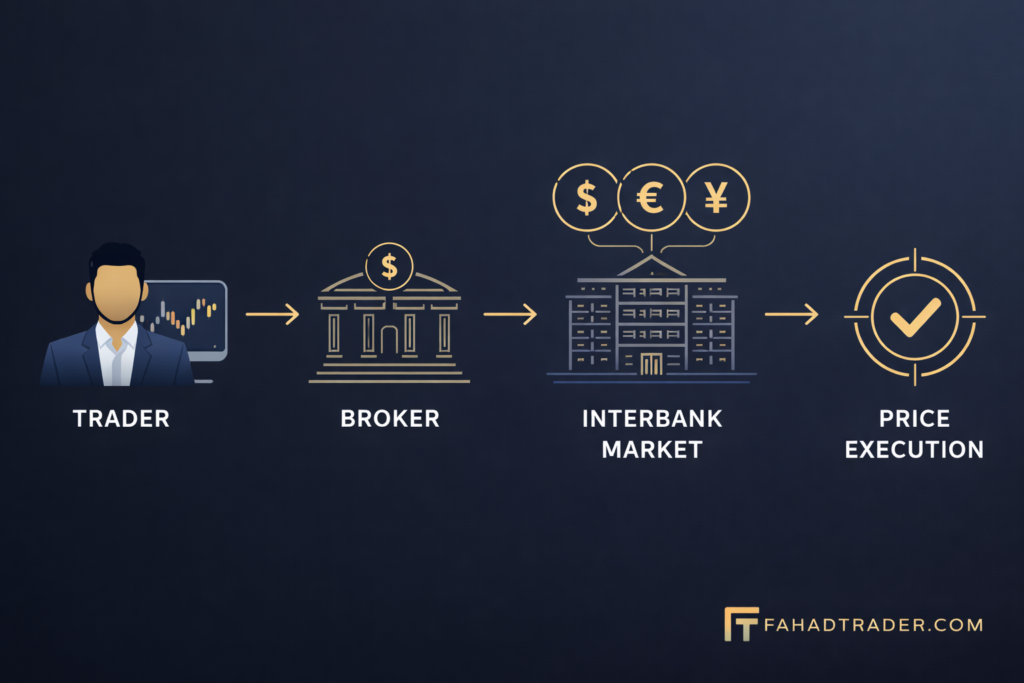
Tier 1 — Interbank Market: Major global banks (Citigroup, Deutsche Bank, Barclays, JPMorgan) trade directly with each other, setting the baseline prices for all currency pairs. This is where the “real” market lives.
Tier 2 — Institutional Traders: Hedge funds, multinational corporations, and central banks operate here, often moving markets with single orders worth billions.
Tier 3 — Retail Brokers and Traders: This is where most readers of this guide participate. Retail brokers aggregate interbank prices and pass them to traders, adding a small spread as their compensation.
The key implication: when you place a trade, you’re not trading directly with a bank. You’re trading a broker’s derived price. Understanding your broker’s execution model — whether they’re a Market Maker or an ECN/STP broker — matters more than most beginners realize
Currency Pairs Explained
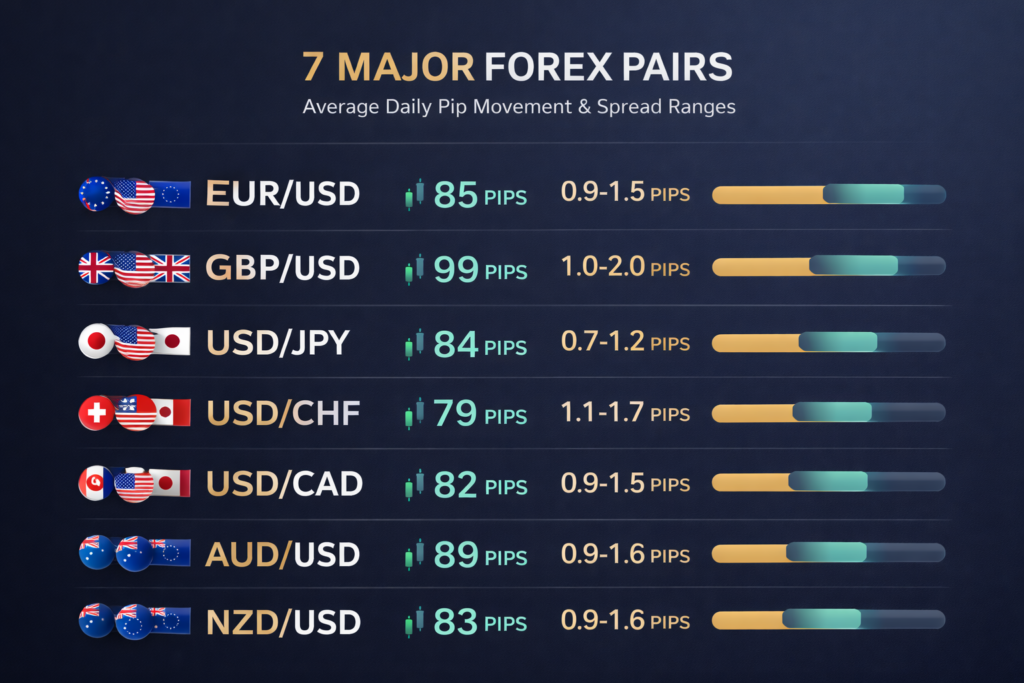
Every forex trade involves a currency pair. The first currency listed is the base currency; the second is the quote currency. The exchange rate tells you how much of the quote currency is needed to buy one unit of the base.
Major Pairs (most liquid, tightest spreads):
PairNicknameAvg. Daily MoveEUR/USD”The Fiber”70–100 pipsGBP/USD”Cable”80–120 pipsUSD/JPY”The Yen”50–80 pipsUSD/CHF”Swissy”50–80 pipsAUD/USD”Aussie”50–90 pipsUSD/CAD”Loonie”50–80 pipsNZD/USD”Kiwi”40–70 pips
Minor Pairs involve two major currencies excluding the USD — such as EUR/GBP or GBP/JPY (“The Dragon”). They carry wider spreads but can offer strong trending behavior.
Exotic Pairs pair a major currency with a currency from an emerging market economy — like USD/TRY or USD/ZAR. High volatility, wide spreads, and thin liquidity make these pairs high-risk for beginners.
For new traders, the professional consensus is clear: master one or two major pairs before exploring others. EUR/USD and GBP/USD offer the deepest analysis resources, the most predictable technical behavior, and the tightest trading costs.
The Four Forex Trading Sessions
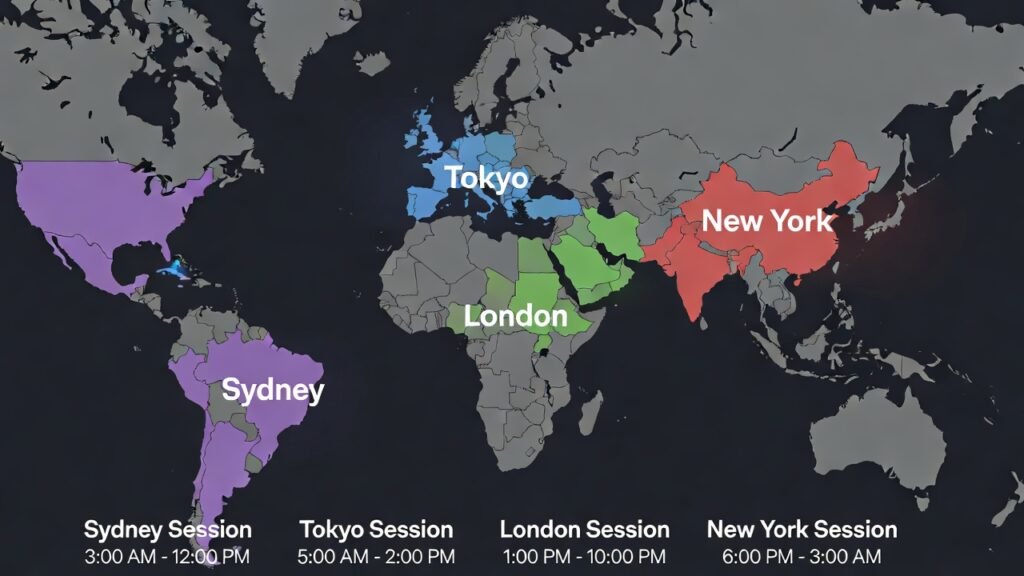
The forex market runs 24 hours, but activity is not uniform throughout the day. Trading volume clusters into four sessions based on when major financial centers are open:
Sydney Session (10:00 PM – 7:00 AM GMT): Low volume, limited volatility. AUD and NZD pairs see the most movement.
Tokyo Session (12:00 AM – 9:00 AM GMT): The first major Asian session. JPY pairs become active. Risk sentiment from Asian equity markets often influences this session.
London Session (8:00 AM – 5:00 PM GMT): The most important session. London accounts for approximately 38% of all daily forex turnover (BIS 2022). EUR, GBP, and CHF pairs see their sharpest moves here.
New York Session (1:00 PM – 10:00 PM GMT): Heavily driven by US economic data releases. The London–New York overlap (1:00–5:00 PM GMT) is the single highest-liquidity window of the trading day.
Serious traders align their strategy to the session where their pairs are most active. Trading EUR/USD during the Tokyo session, for example, is often an exercise in waiting through noise.
How Forex Traders Actually Make Money
Profit in forex comes from one thing: capturing favorable price movement. But the mechanics of how that works involve several concepts worth understanding deeply.
Pips and Pipettes
A pip (percentage in point) is the smallest standard price move for most currency pairs — the fourth decimal place. For USD/JPY (quoted to two decimal places), a pip is the second decimal. A pipette is one-tenth of a pip, used by brokers quoting to five decimal places.
If EUR/USD moves from 1.08500 to 1.08600, that’s a 10-pip move. Whether that earns or costs you money depends on your position size.
Lots and Position Sizing
Forex is traded in lots:
Standard Lot: 100,000 units of base currency (~$10/pip on EUR/USD)
Mini Lot: 10,000 units (~$1/pip)
Micro Lot: 1,000 units (~$0.10/pip)
A trader using a mini lot who captures 30 pips makes $30. The same move with a standard lot produces $300. Position sizing is where risk management begins.
Leverage: Power and Danger
Forex brokers offer leverage, meaning you can control a large position with a small amount of capital. A broker offering 1:100 leverage allows you to control $100,000 with $1,000 of your own capital.
This amplifies both gains and losses equally. At 1:100 leverage, a 1% adverse price move wipes your entire margin on that position. Regulated brokers in Europe and the UK now cap retail leverage at 1:30 for major pairs under ESMA rules for this exact reason.
The professional approach: use leverage as a liquidity tool, not a profit amplifier. Most experienced traders rarely use more than 1:10 effective leverage on any position.
Advanced Techniques Used by Serious Traders
Market Structure Analysis
Before placing any trade, professional traders assess market structure — the pattern of higher highs/higher lows (uptrend) or lower highs/lower lows (downtrend). Trading with the prevailing structure dramatically improves the probability of any individual trade.
Structure breaks — moments when price violates a key swing high or low — signal potential trend reversals. Learning to identify these before they’re obvious is a core skill separating intermediate from advanced traders.
Smart Money Concepts (SMC)
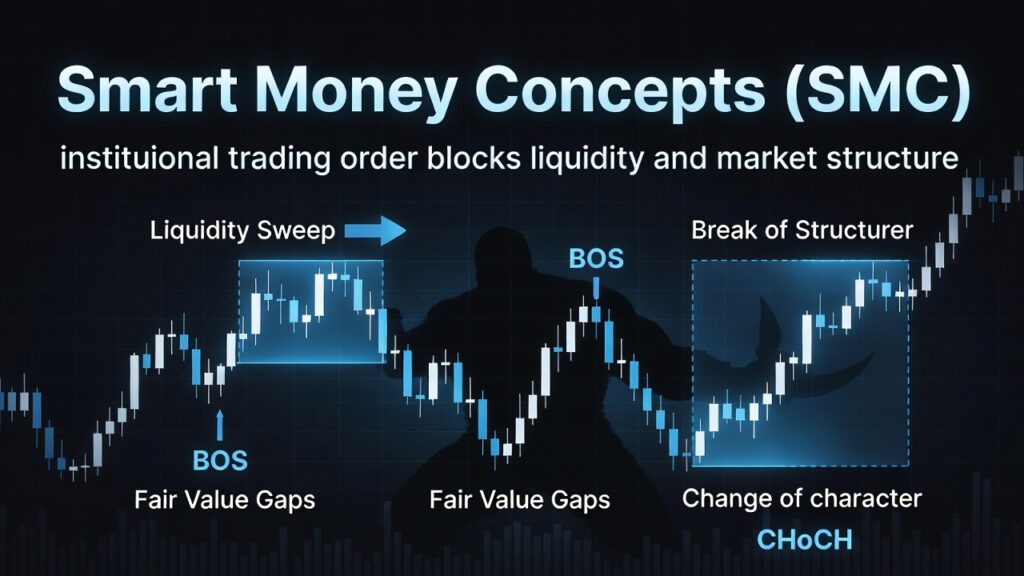
Institutional trading concepts, popularized as “Smart Money Concepts,” focus on identifying where large players are likely accumulating or distributing positions. Key tools include:
Order Blocks: Supply and demand zones created by institutional buy/sell orders
Fair Value Gaps (FVGs): Price inefficiencies left during impulsive moves that price often returns to fill
Liquidity Sweeps: Moves above swing highs or below swing lows designed to trigger retail stop orders before reversing
Professional traders never trade on a single timeframe. A common framework:
Multi-Timeframe Analysis
HTF (Higher Timeframe — Daily/Weekly): Establish trend direction and key levels
MTF (Mid Timeframe — 4H/1H): Identify trade setup zones
LTF (Lower Timeframe — 15M/5M): Time entry with precision
Trading in the direction of the HTF trend while entering on the LTF keeps you aligned with the market’s dominant force.
Correlation Trading
Major currency pairs don’t move independently. EUR/USD and GBP/USD, for example, are historically highly correlated. Trading both pairs in the same direction essentially doubles your exposure to the same risk. Experienced traders monitor correlation coefficients to avoid unintended concentration risk.
From My Trading Experience
The first year I spent trading forex, I did what most beginners do: I jumped between strategies, overtrade during volatile news events, and ignored my stop losses when a trade went against me. I lost money — not because forex doesn’t work, but because I hadn’t built a process.
The turning point came when I stopped looking for the “best strategy” and started focusing on the things within my control: position sizing, session timing, and following a written trading plan.
Here’s what actually changed my results:
I stopped trading during low-liquidity sessions. Most of my losing trades came from setups formed during the Asian session that reversed sharply once London opened. Simply restricting my entries to the London session and its overlap with New York cut my losing trade frequency significantly.
I started journaling every trade with a screenshot. Not just wins and losses — but the why behind each trade. Within three months, a pattern emerged: I was consistently profitable during trend continuation setups but losing on counter-trend trades. I removed the counter-trend setups entirely.
I adopted fixed risk per trade. Every trade risks exactly 0.5–1% of my account, regardless of “how good” the setup looks. This keeps a losing streak from becoming a catastrophe and prevents overconfidence from inflating position sizes after a winning run.
The lesson: forex success isn’t about intelligence or prediction. It’s about process consistency over time.
Risk Management: The Non-Negotiable Foundation
Risk Management: The Non-Negotiable Foundation
Risk management is not a conservative option in forex trading. It is the entire foundation. Without it, no strategy survives long enough to generate meaningful profit.
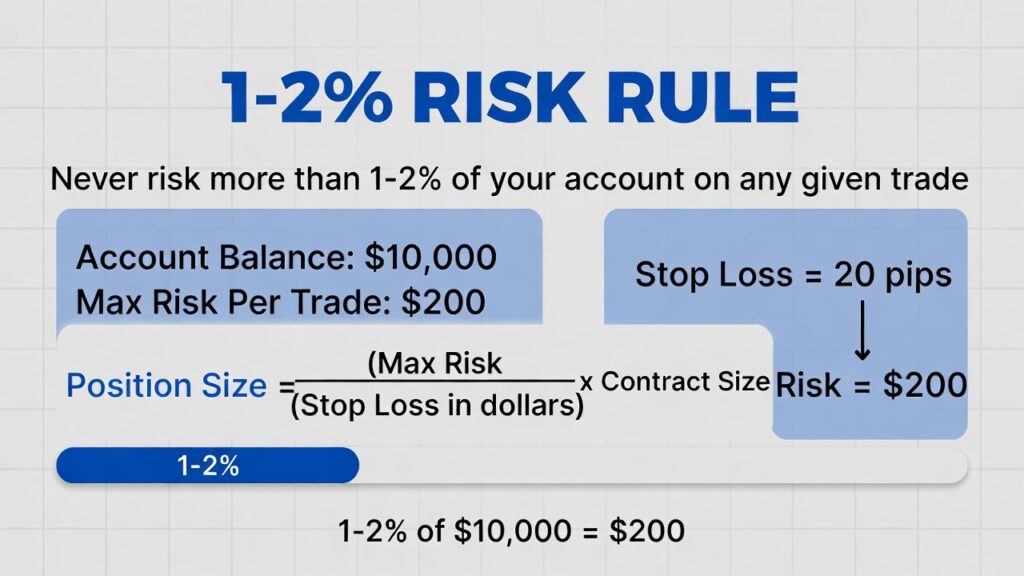
The 1–2% Rule: Never risk more than 1–2% of your total trading capital on a single trade. On a $5,000 account, maximum risk per trade is $50–$100. This seems conservative until you understand that even the best strategies have drawdown periods of 10–15 consecutive losing trades.
Stop-Loss Orders: Every trade should have a predetermined stop-loss placed before entry. Stop-loss placement should be based on market structure (beyond a swing high/low) rather than arbitrary pip distances. Moving stop-losses wider after entry to avoid being stopped out is one of the most destructive habits a trader can develop.
Risk-to-Reward Ratio (RRR): Aim for trades where your potential reward is at least 1.5x–2x your risk. At an RRR of 1:2, you only need to win 34% of your trades to break even. Most traders with a sound strategy win 45–55% of trades — which produces consistent profitability at 1:2 RRR.
Calculating Position Size:
Position Size = (Account Risk in $) ÷ (Stop-Loss in Pips × Pip Value)
Example: $10,000 account, 1% risk = $100 risk. Stop-loss = 20 pips. Pip value on a mini lot = $1.
Position Size = $100 ÷ (20 × $1) = 5 mini lots.
Correlation Risk: If you’re running two similar positions (e.g., long EUR/USD and long GBP/USD simultaneously), you’re effectively risking double your intended amount on USD weakness. Treat correlated pairs as a single combined position for risk calculation.
The Psychology of Forex Trading
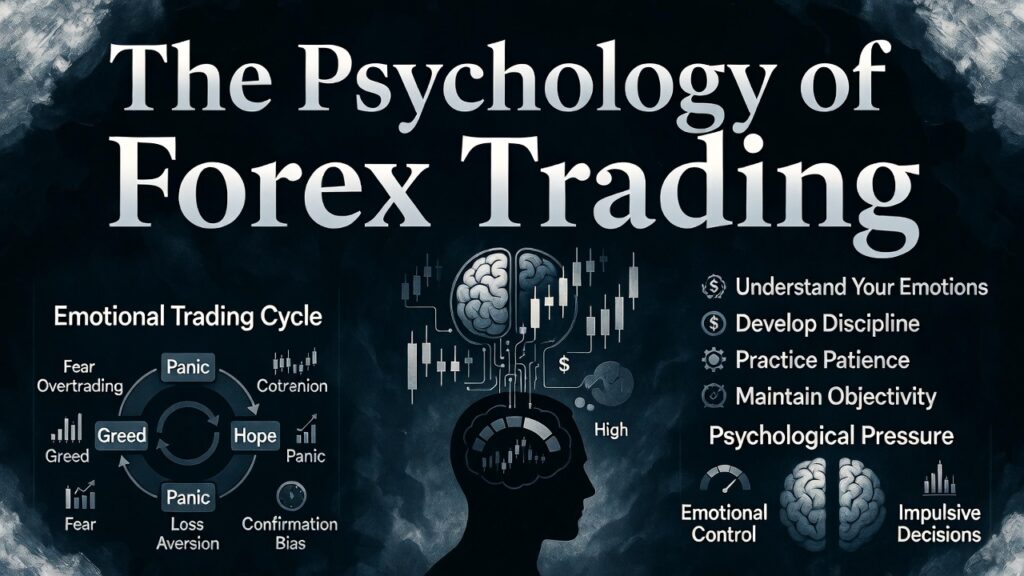
Technical analysis and risk management will take you far. But they won’t save you from yourself.
The forex market is a master at exploiting human psychology. Every retail trader will, at some point, experience:
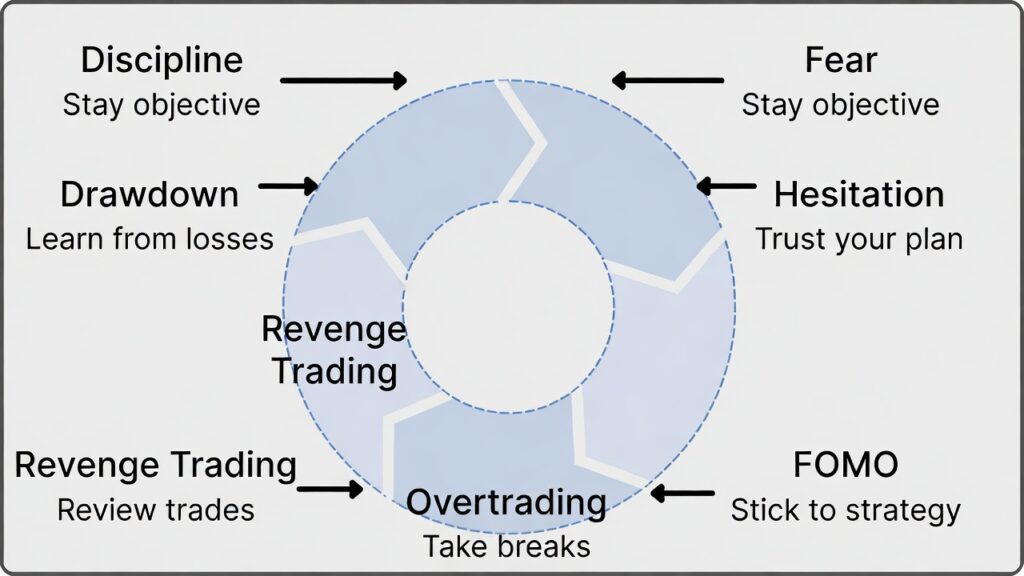
FOMO (Fear of Missing Out): You watched a pair move 150 pips without you. You chase the move. You buy at the top. You lose.
Revenge Trading: A bad loss triggers an emotional drive to “get it back.” You increase position size, ignore your plan, and compound the loss.
Overconfidence after a Winning Streak: Three winning trades in a row and suddenly the rules feel optional. This is typically where significant drawdowns begin.
Analysis Paralysis: Too many indicators, conflicting signals, endless scrolling across timeframes. The perfect setup never comes, and you either don’t trade at all or break and trade impulsively.
The Discipline Framework That Works:
Treat each trading day as a session with strict rules. Maximum 2–3 trades per session. If you hit your daily loss limit (typically 2–3% of account), close the platform. No exceptions. The market will open tomorrow. Your capital needs to be there when it does.
Pre-trade checklists — a 5-step written routine before pressing the buy or sell button — are used by virtually every professional trader. They force a pause between impulse and action.
Common Mistakes That Destroy New Traders
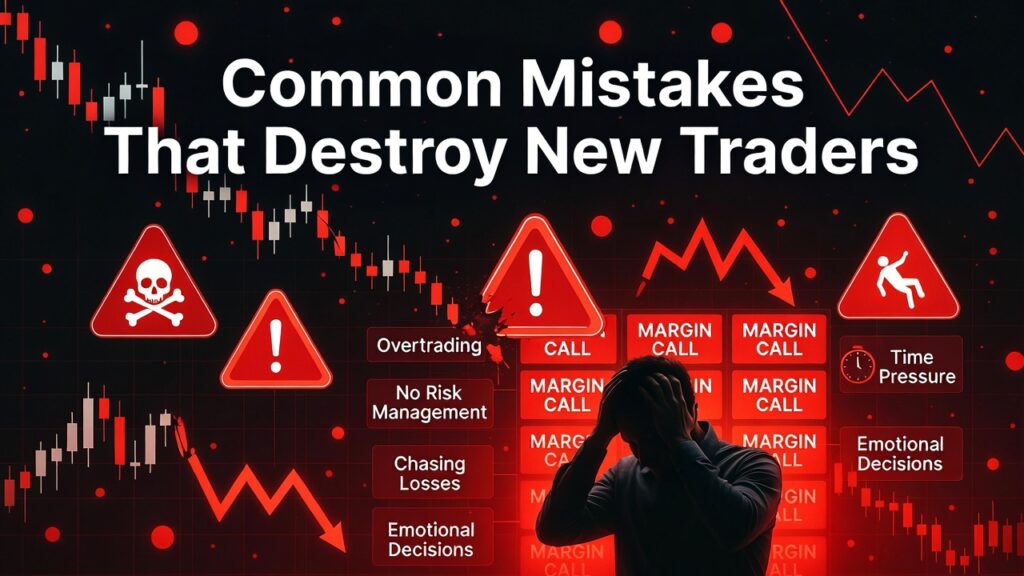
Trading without a plan. Entering trades based on a feeling or a hot tip without a defined entry, stop-loss, target, or risk amount is not trading — it’s gambling with a chart on the screen.
Overleveraging. The accounts that blow up in weeks are almost always overleveraged accounts. High leverage on a bad trade sequence produces catastrophic losses from which recovery is mathematically improbable.
Ignoring the economic calendar. High-impact news events (NFP, FOMC, CPI) can move pairs 100–200 pips in seconds. Trading through these events without awareness is Russian roulette. Many experienced traders simply stay out of the market 30 minutes before and after major releases.
Indicator addiction. New traders pile on RSI, MACD, Bollinger Bands, Stochastic, Ichimoku — and the result is a cluttered chart that contradicts itself. Price action and structure are the primary tools. Indicators confirm; they don’t lead.
Demo trading too short or skipping it entirely. A demo account is where you prove your strategy before risking real capital. The minimum recommended demo period is 2–3 months of consistent profitability before transitioning to a live account.
Failing to record and review trades. Most traders spend more time analyzing charts they didn’t trade than analyzing the trades they actually took. Your trading journal is your most valuable educational tool.
Step-by-Step Framework to Get Started
Step 1 — Learn the fundamentals. Understand currency pairs, pips, lots, leverage, and order types. Resources: Babypips School of Pipsology (free), Investopedia Forex section.
Step 2 — Choose one strategy. Select a single approach — trend following, price action, or smart money concepts. Study it deeply. Avoid switching strategies every week.
Step 3 — Open a demo account. Choose a regulated broker (FCA, ASIC, or CySEC regulated). Practice your strategy on a demo account for at least 60 days.
Step 4 — Build your trading plan. Document your session times, pairs traded, entry criteria, stop-loss rules, take-profit levels, maximum daily loss limit, and risk per trade.
Step 5 — Start keeping a trading journal. Screenshot every trade. Record entry reason, outcome, and emotional state. Review weekly.
Step 6 — Transition to live trading with micro lots. Start with the smallest possible position sizes on a live account. The psychological difference between demo and live trading is significant. Use micro lots to make this transition gradual.
Step 7 — Scale gradually. Only increase position sizes after proving 3–6 months of consistent profitability. Scaling prematurely is one of the most common ways successful demo traders fail in live markets.
Professional Trading Tips
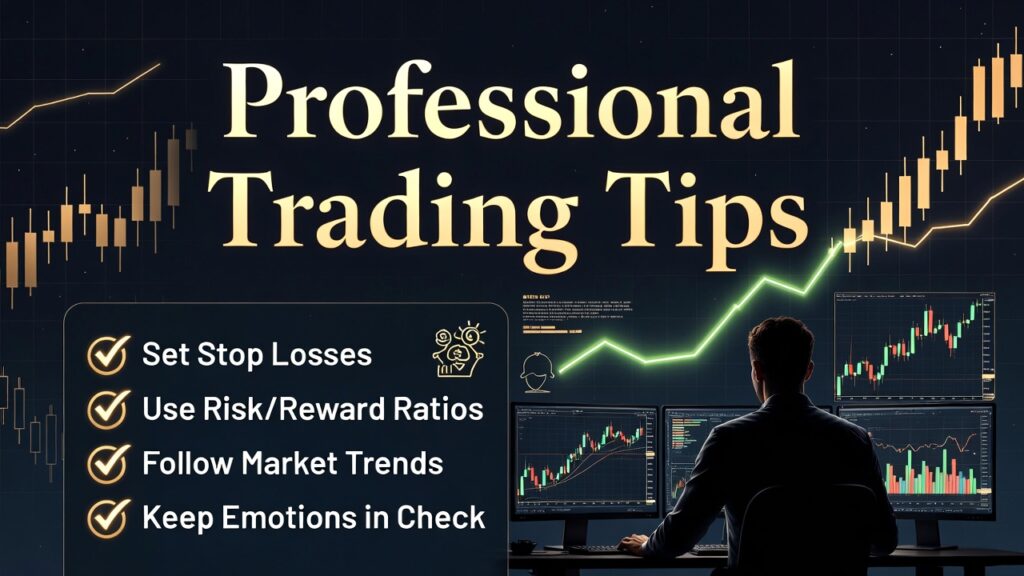
Trade fewer pairs, better. Specialization beats diversification in forex. Deep knowledge of EUR/USD behavior across news events and sessions outperforms a surface understanding of ten pairs.
Know your numbers cold. What is your win rate? Average risk-to-reward? Maximum drawdown? If you can’t answer these without checking, your performance data isn’t guiding your decisions.
Time your entries, not just your analysis. A good analysis with a poorly timed entry can result in unnecessary heat or a stopped-out trade that would have been a winner. LTF entry refinement separates precise traders from imprecise ones.
Treat trading like a business. Your capital is inventory. Your strategy is your business model. Your trading plan is your operating procedure. Your journal is your financial record. Businesses without records don’t last.
Learn to sit on hands. Not every session offers a quality setup. Experienced traders routinely close charts having taken zero trades. The ability to not trade — to wait for high-probability setups — is a skill that takes deliberate development.
Internal Linking Suggestions
“How to Read Forex Charts for Beginners” → Link from the “Currency Pairs Explained” section
“Best Forex Brokers for Beginners in 2025” → Link from the “Step-by-Step Framework”
(Step 3)”Forex Risk Management: The Complete Guide” → Link from the “Risk Management” section
“Forex Trading Sessions: When to Trade” → Link from the “Four Forex Trading Sessions” section
“Forex Trading Psychology: Mastering Your Mindset” → Link from the “Psychology” section
External Authority Source Suggestions
Bank for International Settlements (BIS) — https://www.bis.org/statistics/rpfx22.htm — Reference for $7.5 trillion daily volume statistic
Investopedia Forex Overview — https://www.investopedia.com/terms/f/forex.asp — Supporting definitions for beginners
ESMA Retail Leverage Rules — https://www.esma.europa.eu/press-news/esma-news/esma-agrees-prohibit-binary-options-and-restrict-cfds-protect-retail-investors — Reference for regulated leverage caps
Q1: Is forex trading legal in Pakistan?

Forex trading is legal in Pakistan for individual traders. The Securities and Exchange Commission of Pakistan (SECP) oversees financial markets, and Pakistani traders can legally access international regulated brokers. It is important to ensure the broker you choose holds valid regulation from a tier-1 authority such as the FCA (UK) or ASIC (Australia).
Q2: How much money do I need to start forex trading?

You can technically start with as little as $100 using a micro lot account. However, $500–$1,000 is a more realistic minimum for meaningful practice with proper risk management. To trade with position sizes that produce meaningful income, $5,000–$10,000 is the range most professional traders consider a viable starting capital.
Q3: Can forex trading be a full-time career?

Yes, but the path is long and most traders who attempt it full-time too early fail. The recommended approach is to trade part-time while building a track record of 1–2 years of consistent profitability, then transition gradually. Realistic annual returns for skilled retail traders range from 20–50% — significant, but not the 1,000% figures often advertised.
Q4: What is the best forex trading strategy for beginners?
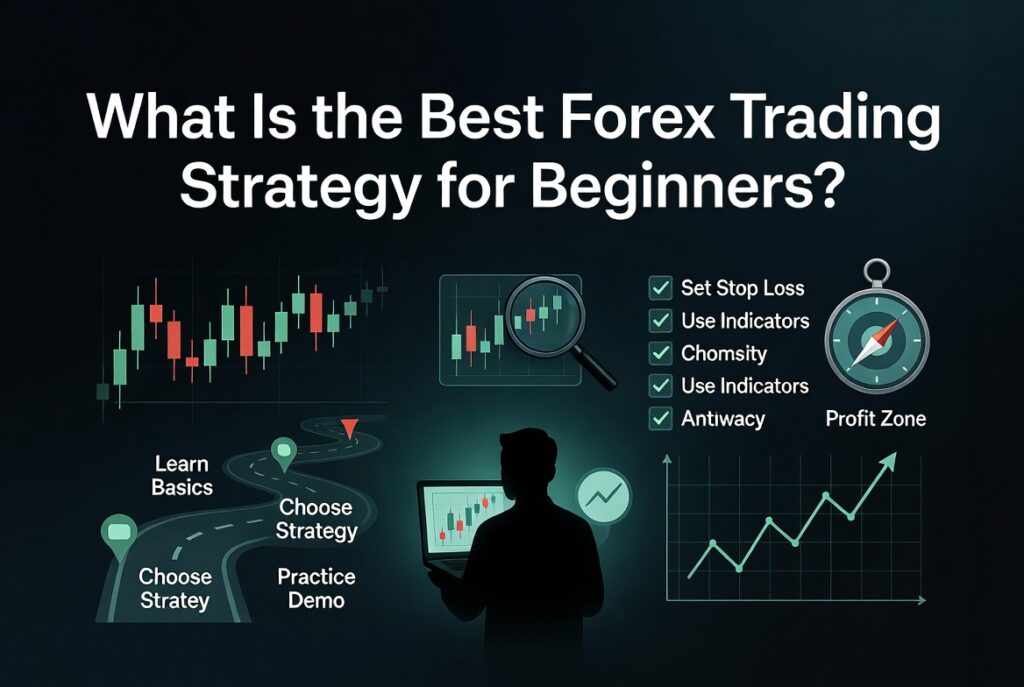
There is no single “best” strategy, but the most suitable for beginners is a straightforward trend-following approach using price action on the 1-hour and 4-hour charts. It requires minimal indicators, relies on logical market structure, and teaches discipline naturally. Avoid scalping and high-frequency strategies as a beginner — they require speed and precision that takes years to develop.
Q5: How do forex brokers make money?
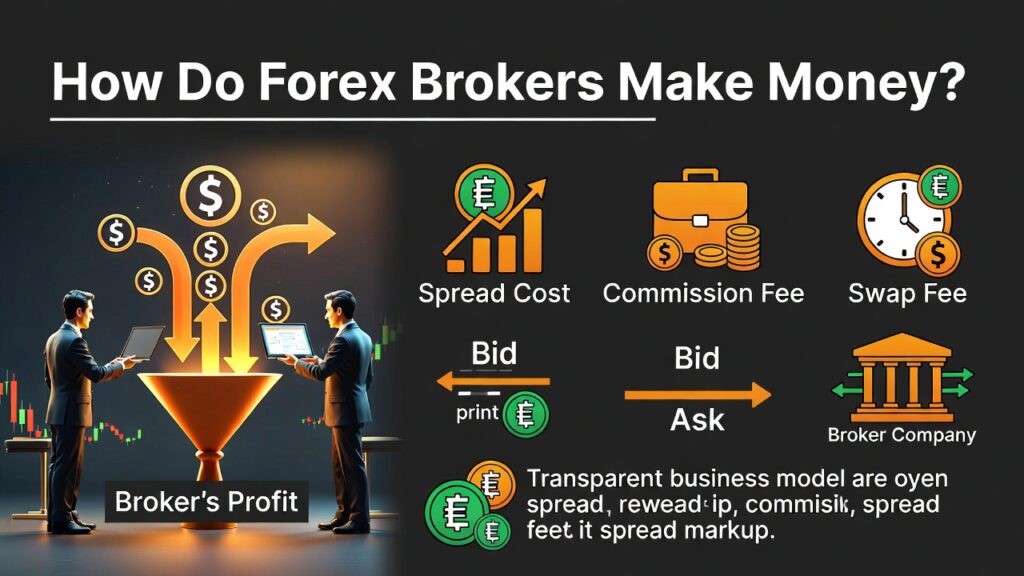
Most retail forex brokers earn revenue through the spread — the difference between the buy (ask) price and sell (bid) price. ECN/STP brokers may charge a small per-lot commission instead, in exchange for offering raw interbank spreads. Market Maker brokers sometimes take the opposite side of your trade, creating a potential conflict of interest. Understanding your broker’s model is a fundamental part of choosing where to trade.
Conclusion
Forex trading is one of the most accessible and genuinely rewarding markets in the world — but it rewards preparation, discipline, and process, not luck or prediction.
You now understand what the forex market is, how it works structurally, what drives price, how professional traders approach risk and psychology, and the concrete steps to move from curiosity to competence.
The traders who succeed long-term are not the ones who found a secret strategy. They are the ones who developed a consistent process, protected their capital obsessively, and kept trading through the learning curve without blowing up.
Your next step: If you haven’t already, explore our Free Forex Course for Beginners and our Recommended Broker Guide to take your first concrete step toward becoming a consistent trader.
Questions, comments, or want a strategy reviewed? Drop them in the comments below — I personally respond to every one.
About the Author

Fahad is a professional forex trader and the founder of FahadTrader.com, an educational platform dedicated to helping traders build sustainable, process-driven trading businesses. With years of live market experience across major and minor currency pairs, Fahad specializes in price action, market structure, and trading psychology. His work focuses on cutting through the noise and giving traders the honest, experience-based education the industry rarely provides.
⚠️ Financial Disclaimer

The content on FahadTrader.com, including this article, is provided for educational and informational purposes only. It does not constitute financial advice, investment advice, or a recommendation to buy or sell any financial instrument. Forex trading involves substantial risk of loss and is not suitable for all investors. Past performance is not indicative of future results. Always conduct your own due diligence and consider consulting a licensed financial advisor before making any trading decisions. Trading leveraged products carries a high level of risk and may not be appropriate for all investors. You could lose more than your initial deposit.